Internationales Festival Zeichen der Nacht - Berlin - International Festival Signs of the Night |
|
11. Internationales Festival Zeichen der Nacht / Berlin Edition
24th International Festival Signs of the Night / Worldwide
June 9 - 14, 2026
Kino & Bar in der Königstadt - - - Straßburger Straße 55 - - - 10405 Berlin (Prenzelberg) |
|

|
|
Maia Lekow, Christopher King |
Kenya / 2025 / 1:40:00 |
In 1931, when the McMillan Memorial Library was built in Kenya’s capital Nairobi, the stately building was reserved for white Europeans only. It wasn’t until 1958, not long before the British colony gained independence, that the library was finally opened to Kenyans—though its collection remained exclusively white. In 2017, writer Shiro Koinange and publisher Angela Wachuka were given the mandate to restore the dilapidated library and two satellite branches, and to adapt them to the contemporary needs of a more diverse audience. They enthusiastically set about raising funds, overseeing renovations, and recruiting young talent to help catalog the collection.
But it soon became clear that the project came with complex challenges, such as making the right political connections, bridging the intergenerational divide between staff members, and deciding how much of the library’s fraught colonial history should remain in the collection. For a five-year period, we follow these inspiringly energetic women and their tireless efforts to transform the library into a creative hub for the whole of Kenyan society.
| |

|
JURY DECLARATION
The jury gives the Main Award to How to Build a Library for its powerful affirmation of knowledge, freedom, and collective responsibility. The film follows an extraordinary effort of two remarkable women to reclaim a cultural institution, but its message reaches far beyond Kenya. With humanity, intelligence, and hope, it reminds us that freedom, like air, is often noticed only when it is threatened – and that education remains one of the most powerful tools for protecting.
|
SIGNS AWARD
The Signs Award for Documentary honors films, which express in a
surprising and sensitive way the perturbing aspects of reality
|
|
|
Manuel Besedovsky |
Argentina / 2024 / 1:35:00 |
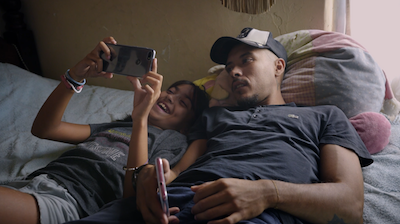
Luciano cuts a slight figure as he wanders through the narrow streets of the improvised Barrio Tablada on the edge of Rosario, taking care of his mother and sister and the makeshift home they share, finding occasional work on building sites as the search for a proper job continues, lifting weights at the gym. Manuel Besedovsky lays out the different episodes of this precarious, if not atypical existence with such deliberate deemphasis that it feels almost like a plot twist when Luciano meets with a consultant to talk about the various options for constructing a penis. And yet this part of Luciano’s experience has actually been there all along – another thread woven often imperceptibly into the fabric of the film with gentleness and care.
Handing CVs out, hormone injections, smoking joints with buddies from the neighbourhood, talking to his mother about the daughter that is no longer there, some slightly awkward rapping, thinking about having children – the most radical thing about this portrait is how each challenge, each diversion, each encounter is presented with the same sense of normality with which Luciano experiences it. Class, gender identity and their seldom-seen intersection shown as nothing more than getting on with life
| |
|
JURY DECLARATION
The Jury were deeply moved by the humanity of this film which starts out as the intimate portrait of an average young man with only some problems. However this man was ten years before a beautiful young girl. Then the film treats Luciano`s questions of identity, class and survival with remarkable tenderness and without turning its protagonist into a symbol. Even more powerful is the knowledge that Luciano is no longer alive, which gives the film an unexpected emotional weight.
|
NIGHT AWARD
The Night Award for Documentary honors films, which represent reality
in an ambivalent and enigmatic way, avoiding stereotypes of
representation and simple conclusions
|
|
|
Inna Sahakyan, Ruben Ghazaryan |
Armenia, Netherlands / 2025 1:24:00 |
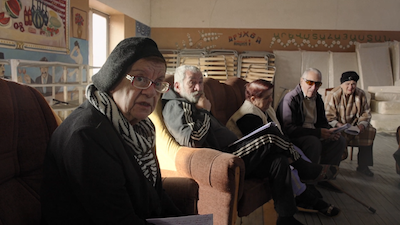
In an Armenian retirement home, a theater director sets out to stage Shakespeare’s Sins with a cast of residents. In the play, Shakespeare’s characters call him to account for their tragic fates—it’s a story that in rehearsal sparks conversations about love, life, and loss.
We follow the residents from casting to premiere. As the group grows closer, we see how the tragedies onstage are reflected in their own lives, which also feature love, betrayal, mourning, and exile. One resident finds and loses her Romeo, another is cast out by her own son, and yet another—who had briefly returned to her home in Artsakh (the Armenian name for Nagorno-Karabakh) after the ceasefire of a war still present in the region—must come back to the retirement home following the forced displacement of the entire Armenian population by Azerbaijan.
What begins as a light-hearted look at aging becomes an exploration of the loneliness and loss that so often accompany it. The dilapidated Soviet-era retirement home itself plays a supporting role, with its peeling paint, prowling cats, and modern care robot all coexisting under the same roof
| |
|
JURY DECLARATION
This warm-hearted, beautifully photographed film impressed the jury in its way it naturally connects Shakespeare’s tragedies with the lives of the residents. It is full of warmth, humour and sadness, but never becomes sentimental. The film reminds us that ageing is not the end of life, but another chapter of it.
|
DIRECTOR STATEMANT
When we started this project, we thought the theater would be the main focus, showing how art can heal and bring new meaning to the elders. However, as we spent time with our protagonists, we realized their personal lives are just as deep and tragic as the plays Shakespeare wrote. It is a true honor that the jury noticed the profound human dramas behind the humor and friendship. These realities are heavy, yet as beautiful as life itself. Thank you to the Internationales Festival Zeichen der Nacht and the amazing jury for this recognition.
|
EDWARD SNOWDEN AWARD
The Edward Snowden Award honors films, which offer sensitive (mostly) unknown informations, facts and phenomenons of eminent importance, for which the festival wishes a wide proliferation in the future.
|
|
Fear Fokol |
Tuva Bjork |
/ Sweden / 2025 / 0:15:00 |
There are 550,000 private security personnel in South Africa—outnumbering all of the country’s police and military combined. They are part of a security industry worth billions. With inequality and crime there having reached extremely high levels, the industry exploits the fears of primarily white wealthy citizens by offering weapons, fences, surveillance systems, and drones. In Fear Nothing, Tuva Björk follows the security guards who protect Johannesburg’s elite, day and night. A disturbing picture emerges of ingrained racism, militarization of public spaces, unlawful violence, toxic masculinity, and sadism—all presented under the guise of “love for the job.” Ultimately, these security measures don’t make people feel any safer; instead, they fuel an atmosphere of constant tension and paranoia.
|
|

|
JURY DECLARATION
The Jury appreciated how the film reveals an entire industry built around fear. It exposes mechanisms of inequality and security without becoming didactic, allowing viewers to draw their own conclusions. |
|
DIRECTOR STATEMENT
To make this film, I contacted around eighty private security companies in Johannesburg before one finally agreed to let us in. That process alone revealed something about the scale of the industry and how closed this world is.
The company we followed offered a rare portal into the fears, desires, and anxieties of Johannesburg's wealthy residents, as well as those employed to protect them. What interested us most was not crime itself, but the ways fear can become a commodity, transformed into architecture, services, and ultimately, a very effective business model.
Many of the company's clients seemed haunted by an imagined threat: a dangerous and heavily armed Other lurking just beyond their walls. Yet the only people we encountered who resembled this fantasy of permanent vigilance were often the managers selling that fear themselves.
Instead of seeking to condemn them, I wanted to asks how fear operates, how it shapes societies, and how systems built on fear not only affect those cast under suspicion, but also come to imprison those who sustain them. At a time when industries around the world continue to profit from fear and separation, I still want to believe cinema can help us look beyond those divisions and expand the limits of our empathy.
|
|
|
|
Zvika Gregory Portnoy, Zuzanna Solakiewicz |
Poland, Qatar / 2024 / 1:18:00 |
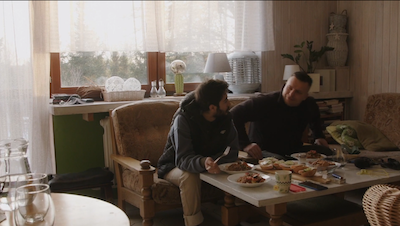
Maciek lives in a Polish village close to Belarus. It is winter 2021; the whole area has turned into a military zone, patrolled by border guards searching for “illegals” and pushing them back to Belarus. One day, Maciek’s mother lets an exhausted Syrian refugee into their house. Constructed like a thriller, this flawlessly executed film calls into question our definition of humanity.
| |
|
JURY DECLARATION
We give the prize for the film’s powerful and deeply compassionate portrayal of people who are stuck between country borders, often reduced to numbers, headlines, and political rhetoric. By focusing on a single encounter with a Syrian refugee the film restores individuality and dignity to those who are usually seen only as part of a migration crisis. In doing so, it reminds us that humanity begins with the ability to recognize ourselves in the lives of others. |
|
DIRECTORS STATEMENT
To all those who are forced to move, to leave home and begin again: your courage teaches us to be brave enough to change. |
|
|
|
Teboho Edkins |
France, Germany, South Africa / 2025 / 0:38:06 |
In one of two Boeing crashes caused by a software error six years ago, 157 people died, including my brother Max. I travelled with my father to the crash site in search of some- thing tangible in our grief. There, we met people for whom mourning is a profound part of their culture – a humanity contrasting with the manufacturer’s calculated stance. Teboho Edkins grew up in southern Africa and lives and works in Cape Town and Berlin. His films have been shown at over 500 film festivals and in various group and solo exhi- bitions, including at the Centre Pompidou and Tate Gallery of Modern Art.
| |

|
JURY DECLARATION
What stayed with us is the honesty of this observational documentary. It speaks about cultural spheres crossing grief without simplification and finds a way to connect a personal loss with larger questions of responsibility and memory. The result feels both intimate and universal. |
|
|
|
Kethiwe Ngcobo |
United Kingdom, South Africa / 2025 / 1:43:00 |
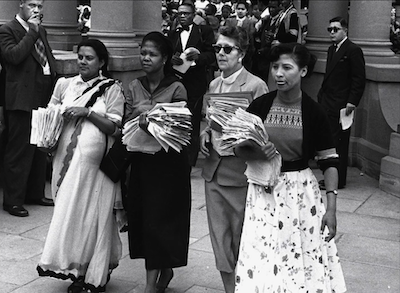
And She Didn’t Die tells the life story of South African writer and resistance fighter Lauretta Ngcobo, as seen through the eyes of her daughter, film director Kethiwe Ngcobo. Lauretta grew up in KwaZulu-Natal, became involved in the struggle against apartheid through her husband AB Ngcobo, leader of the Pan African Congress, and eventually fled to London. In exile, she found the freedom to write—becoming one of the first Black women to gain a literary voice. The director interweaves home videos, archival material, interviews, passages from books, and re-enacted scenes into a richly layered portrait blending the personal and the political. Kitchen table conversations about hairstyles and cultural traditions counterpoint reflections on the role of rural women in the anti-apartheid struggle. The oral storytelling tradition, in which her mother’s books are also rooted, has a central role. Kethiwe Ngcobo continues this theme through the medium of cinema. The result is a portrait not only of Lauretta, but also of the many other women who co-wrote history. A tribute to the power of stories as a form of resistance, healing, and cultural transmission.
| |
|
JURY DECLARATION
The Jury gives Special Mention to this film for its moving portrait of South African writer Lauretta Ngcobo, whose life embodies courage, resilience, and an unwavering commitment to justice. Through her story, the film connects personal memory with larger histories of exile, struggle, and resistance, showing how individual lives can carry and preserve collective history. |
|
MENTION FOR THE SIGNS AWARD
|
|
Köyhyys pelastaa |
Juhani Johannes Koivumäki |
Finland / 2026 / 0:15:45 |
"Poverty Saves" tells about Pentti-Otto Koskinen (b.1952), a performance artist who after abandoning the art world, proclaims that poverty saves.
| |

|
JURY DECLARATION
We mention this film for its original and thought-provoking exploration of poverty, dignity, and social exclusion. With remarkable sensitivity, the film portraits an old unconventionally thinking artist who challenges conventional ideas of success and invites us to reconsider what it means to live a meaningful life. |
|
DIRECTOR STATEMENT
The process of making this film took about five years. I, as a filmmaker feel myself as a middle-man for giving out Pentti-Otto's message. I am very much aware how challenging ideas we are dealing with. So it is wonderfully surprising to have understanding and appreciation for these thoughts and feelings. It is meaningful to surpass limitations of conventions and benefit-seeking patterns of being. |
|
SPECIAL MENTION FOR THE NIGHT AWARD
|
|
|
Cecilia Araneda |
Chile, Canada / 2025 / 0:38:56 |
In Epitaph, filmmaker Cecilia Araneda returns to her long-estranged homeland, eco-processing 16 mm film with leaves and fruit gathered from her ancestral home, weaving a lament for her family’s past and the vanishing landscapes of home. Filmed in both Chile and on the Tablelands in Canada, a site central to the modern understanding of plate tectonics, Epitaph incorporates eco-processed 16 mm footage, video, documents from public and private archives, and found footage to weave an epitaph to a home in the process of leaving the filmmaker, first as a result of exile and then to the gradual movement of time. Epitaph has been eco-processed on-site in rural Chile at the site of the filmmaker’s father’s family using boldo, figs, fig leaves, walnut leaves, apples, apple leaves, fall grapes, fall grape leaves, olives, olive leaves, plums, mint, yard flowers and other vegetation.
|
|

|
JURY DECLARATION
Visually, this is one of the strongest films in the programme. We were fascinated by the way landscape, archives and handmade film processes become part of the story itself. Even when the narrative feels fragmented, the film creates a powerful sense of loss and belonging. |
|
DIRECTOR STATEMENT
My film "Epitaph" is a process-based documentary focused connecting landscape and personal and collective history with the materiality of the film itself. I’m appreciative that this very personal film stood out to your jury.
|
|
SPECIAL MENTION FOR THE OSWALD SNOWDEN AWARD
|
|
|
Florent Tillon |
France / 2026 / 1:37:00 |
With ghost hunters, exorcists, tarot readers, Luciferians and transhumanists from Detroit, an adventure in the form of an investigation into spiritual mutations and new religions in the USA.
|
|
|
JURY DECLARATION
We give the Special Mention for the film’s and thorough historical exploration of this emblematic American city, of beliefs, spiritual mutations, and an overall contemporary American uncertainty. The film appears to move through strange and unstable realities without reducing its subjects to simple explanations. The film offers a rare glimpse into contemporary spiritual subcultures and new belief systems, while remaining curious rather than judgmental. It works particularly well as an investigation into how people search for meaning today. |
|
|
|
|


