Internationales Festival Zeichen der Nacht - Berlin - International Festival Signs of the Night |
|
11. Internationales Festival Zeichen der Nacht / Berlin Edition
24th International Festival Signs of the Night / Worldwide
June 9 - 14, 2026
Kino & Bar in der Königstadt - - - Straßburger Straße 55 - - - 10405 Berlin (Prenzelberg) |
|

|
Dong Shen Shi |
Guoju Wang |
United Kingdom, China /2025 / 0:29:5 |
In Chinese, ‘golden-age’ and ‘mirage’ share the same sound. Amid the 2024 economic decoupling, a single mother struggling to keep accessories business afloat in Yiwu, China’s largest export hub, must come to terms with memories of her late father's orchid on the Winter Solstice and reclaim her opera job to fund her son's overseas study. It enters into a dialogue with the early styles of Tsai Ming-liang and Chantal Akerman.
|
|

|
JURY DECLARATION
The jury gives the Main Award to A Winter Mirage for its remarkable overall achievement, combining social observation, emotional depth, and a precise cinematic sense of place. Through the story of a Chinese business woman, the film opens a wider reflection on economic change, memory, care, and the fragile promises of a better future. The film captures how larger social and economic transformations in Chinese society quietly enter everyday life, shaping relationships, memories and expectations for the future.
|
|
DIRECTOR STATEMENT
A Winter Mirage is based on the true story of my mother, Ailian, and follows just one day in her life.
She began learning Wu Opera at 14, became a lifelong actress in a state-run opera house at 16, and later, in 1994, left that secure position to enter the free market in Yiwu, the city where I grew up. At that time, Yiwu symbolized the promise of China’s private economy and the possibility of a new life.
Today, as the economic landscape changes, she finds herself uncertain whether to continue her business or return to the state system as an opera teacher. Her hesitation is personal, but it also reflects a wider condition shared by many people.
I chose an observational approach and a static camera to capture this feeling of waiting, uncertainty, and emotional stillness.
In Chinese, “golden age” and “mirage” share the same sound. Through this intimate portrait, I hope the film can reflect on the fragility of prosperity, and reveal the tenderness and courage of those living within that uncertainty.
Thank you again for this meaningful recognition.
|
|
SIGNS AWARD
The Signs Award honors films, which treat an important subject in an original and convincing way
|
|
|
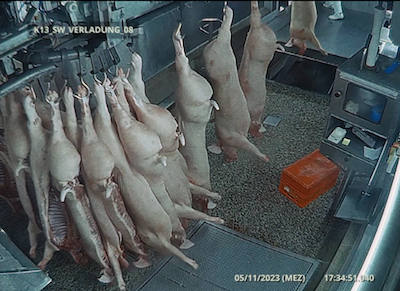
Simon Schneckenburger |
Germany / 2024 /0: 29:59 |
Two men displaced in the hell of the German meat industry. Something lies between them. Something makes them dream again.
|
|
|
JURY DECLARATION
For its convincing treatment of labour exploitation, migration, bodily vulnerability, and intimacy. The film approaches a socially urgent subject through human closeness rather than abstraction. |
|
NIGHT AWARD
*
The Night Award honors films, which are able to balance ambiguity and complexity characterized by enigmatic mysteriousness and subtleness,
which keeps mind and consideration moving
|
|
Généalogie de la violence |
Mohamed Bourouissa |
France / 2024 / 0:15:00 |
A young man sits in the car with his girlfriend. An unmarked police car pull up to command a routine identity check, under the dismayed eyes of his girlfriend.
|
|

|
JURY DECLARATION
The Night Award recognises films that keep thought in motion through ambiguity, complexity, and subtle tension, and 'Genealogy of Violence" achieves this through one apparently simple but deeply unsettling situation. The film’s quiet intensity leaves the viewer with unresolved questions about power, visibility, intimacy, and the violence embedded in everyday structures of partly xenophobic societies. Through its sound and visual language, it does not simply depict violence but makes it felt almost physically. |
|
EDWARD SNOWDEN AWARD
*
The Edward Snowden Award honors films, which offer sensitive (mostly) unknown informations, facts and phenomenons of eminent importance, for which the festival wishes a wide proliferation in the future
|
I Do Not See When Shooting
|
| |
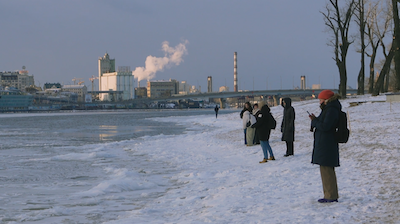
Anastasia Stetsenko |
Ukraine / 2025 / 0:15:40 |
Two friends drift through Kyiv’s »yebenya« (Ukrainian slang: a remote, forgotten place — literally »the ass-end of nowhere«), hopping city trains, tracing smokestacks, and power lines of Ukraine’s wounded electrical grid, chatting about the (in)ability to cry. An old DV camera is obsessed with smoke dissolving into clouds, its gaze repeatedly cut by military commands enforcing martial law: »Look, how beautiful.«— »I don’t care. Delete it.« They erase — and film again. Filming becomes defiance, a way to insist on being alive. The trembling image searches for something to hold onto in a stifling reality, pausing on a familiar face and zooming in on teary eyes. »I really need this.« A raw, electrifying debut, where choosing what to see becomes an act of resistance.
| |
|
JURY DECLARATION
The Edward Snowden Award honours films that reveal sensitive and urgent realities deserving wider attention, and "I Do Not See When Shooting" gives form to the experience of filming, living, and resisting within a wounded city in a country during a war. Its images expose the fragile act of seeing itself as a gesture of survival and defiance, questioning what can be shown, what remains invisible, and how reality is remembered through images.
|
JURY AWARD FOR FOR A CHILD’S PERSPECTIVE
|
|
|
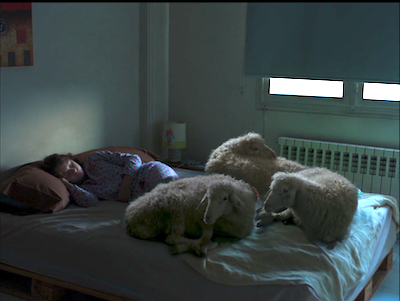
Hadi Babaeifar |
Iran / 2024 / 0:13:15 |
Rose, a little girl in Tehran, lives with her mother and her dog. She discovers that her neighbours are killing sheep. Her mother explains that the animals are being sacrificed in a traditional ritual where their meat is cooked and distributed among people. Rose considers it foolish to follow this old tradition in modern life. She decides to save the remaining sheep.
| |
|
JURY DECLARATION
The Jury Award goes to Sheep for the clarity and strength with which it approaches a moral conflict through a child’s perspective. The film’s simplicity becomes its force, allowing questions of tradition, empathy, and resistance to emerge with direct emotional power.
|
|
|
Dorian Jespers |
Belgium, France, United Kingdom, North Macedonia / 2025 / 0:25:05 |
In 19th-century Liverpool, we follow a trial that is as baroque as it is absurd, one that unfolds more like a spectacle than a legal proceeding: a corpse, with no name or origin, falls from the sky and is brought to court. Rules are cited, invented, followed, ignored, and disregarded; compromises and solutions are sought and found—unless fate intervenes once again. A film like a painting. One might almost think that this is not about law and justice, but about a compromise that looks beyond words for an external scapegoat and ensures cohesion. The chaos and confusion that remain in the process relegate the defenseless corpse to its place as a scapegoat. It is less about guilt than about its mere existence and function, which provides an occasion for the (self-representation of the living.
|
|

|
JURY DECLARATION
For its highly original use of grotesque historical form to reflect on law, guilt, and social projection. The film stands out for its conceptual boldness and intellectual force.
|
|
|
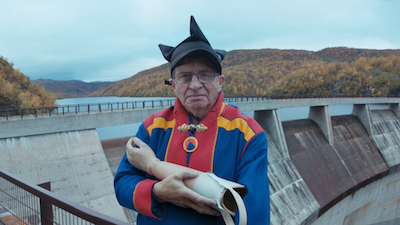
Marja Helander, Liselotte Wajstedt |
Norway / 2025 / 0:23:00 |
An exploration of the personal and historical struggles of the Sámi people, navigating imprisonment, protests, and surreal encounters, providing a unique insight into one man’s extra- ordinary journey.
|
|
|
JURY DECLARATION
For its sensitive and original exploration of personal and collective memory. Through the extraordinary journey of one Sámi man, the film reveals a history of resistance, resilience, and cultural survival that remains too rarely seen on screen.
|
DIRECTOR STATEMENT
We am very proud and happy that you gave our film a special mention award. It means a lot that you see our film and this important theme. We need to keep working for the nature and indigenous rights.
|
|
MENTION FOR THE SIGNS AWARD
The Signs Award honors films, which treat an important subject in an original and convincing way
|
|
Vieras |
Arman Zafari |
Finland / 2025 / 0:22:00 |
Short on money, Maija turns up at her son Mikko's party uninvited. Not having seen his mother for years, Mikko is forced to welcome the new guest.
|
|

|
JURY DECLARATION
For its convincing treatment of labour exploitation, migration, bodily vulnerability, and intimacy. The film approaches a socially urgent subject through human closeness rather than abstraction.
|
MENTION FOR THE SIGNS AWARD
The Signs Award honors films, which treat an important subject in an original and convincing way
|
|
|
Susann Maria Hempel |
Germany / 2025 / 0:12:30 |
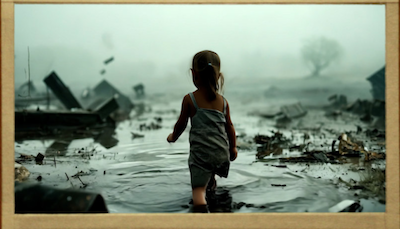
"Hope Road" reflects the filmmaker’s artistic journey in a world shaken by crises and wars, as the mother of a small child whose existence seems to demand something dif- ferent from her than the production of art. While the ‘old world’ of the artist founders, she escapes from the dysto- pian scenarios of the present by taking up the child’s point of view.
| |
|
JURY DECLARATION
For its moving portrayal of a mother trying to imagine a future for her child in a world marked by instability and fear. The film transforms a private conversation into a universal reflection on responsibility, vulnerability and hope.
|
MENTION FOR THE NIGHT AWARD
The Night Award honors films, which are able to balance ambiguity and complexity characterized by enigmatic mysteriousness and subtleness,
which keeps mind and consideration movingcing way
|
|
|
Francesco Thérèse |
Italy / 2025 / 0.08:29 |
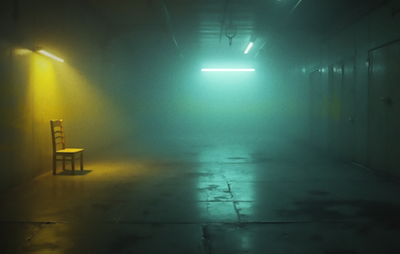
For decades, Ruth has been waiting for the return of her twin sister, who left on a space mission. In a stream of thoughts suspended between memory, childhood, and absence, she recalls their secret game: whoever spots a yellow car first, wins. But in the silence of such a deep absence, the echo of that game turns into poetry, memory, and waiting.
|
|
|
JURY DECLARATION
For its poetic ambiguity and its suspended atmosphere between memory, absence, and waiting. The film keeps its emotional meaning open through restraint and mystery.
|
JURY DECLARATION
The ambition behind "Yellow Liminal" is to give tangible form to absolute emotions, much like a Rothko painting. I wanted to portray, visually, two different aspects of the same character: Ruth, an elderly woman. The first aspect is tied to fragile memory, absence, and confusion. I chose to work with artificial intelligence, embracing its social and cultural significance: a largely unexplored territory, filled with questions, suspicion, and wonder. Through it, I created liminal spaces in which to situate Ruth’s stream of consciousness. The second aspect concerns Ruth’s physical presence, her existence in flesh and blood. For this, I chose celluloid film, perhaps the most tangible and material medium available to us. "Yellow Liminal" is built upon the contrast between something ethereal and elusive, and something deeply tangible and concrete. Just like human existence itself.
|
MENTION FOR THE EDWARD SNOWDEN AWARD
*
The Edward Snowden Award honors films, which offer sensitive (mostly) unknown informations, facts and phenomenons of eminent importance, for which the festival wishes a wide proliferation in the future
|
Death of a Fantastic Machine
|
|
Axel Danielson, Maximilien Van Aertryck |
Sweden / 2025 / 0:17:21 |
A visual essay examining how cameras and their economic exploitation shape our perception of reality, fueling political division in today's media-saturated world.
| |

|
JURY DECLARATION
For exposing how image economies, cameras, and media systems shape public reality and political division. The film makes visible mechanisms that are often accepted as neutral parts of contemporary life.
|
|
|
|


